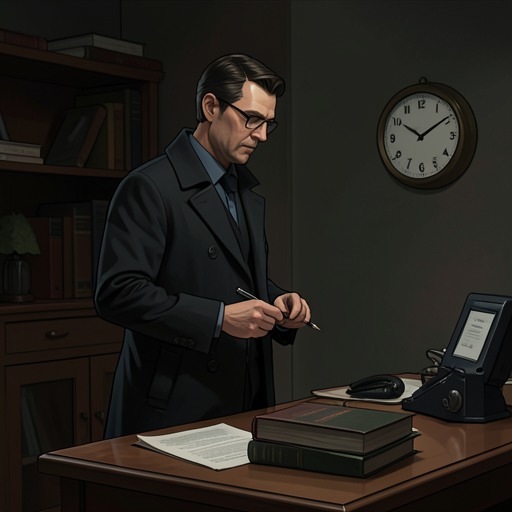
George Stark’s physical degeneration
The Dark HalfGeorge Stark’s physical degeneration is the visible cost of his failing cohesion: although his body can regenerate a wound, his appearance steadily deteriorates, and he comes to believe that writing again with Thad Beaumont is the only way to reverse the decline. The condition links Stark’s bodily survival to the fiction that created him, turning his demand for another book into a struggle against disintegration.
Signs of Regeneration and Collapse
After Stark holds his injured hand beneath cold running water, the light visible through the wound becomes dimmer and more distant. The opening is closing, and his body appears to possess remarkable regenerative power. Yet this recovery does not mean that he is becoming whole. Stark sees the contradiction plainly: his body can repair a local injury while he is, in a larger sense, falling apart. The phrase “Losing cohesion” gives that collapse a name, making the wound both a concrete sign of bodily change and an image of his unstable existence.
His face reinforces the divide between repair and deterioration. Looking at it for an extended time can draw him toward a trance; it is familiar to him, yet increasingly strange. The mirror thus offers no stable reassurance. It presents a face that belongs to him but no longer seems fully recognizable, reflecting the broader instability of a body that can close a wound while losing its coherence.
A Face That Changes
When Stark first sees his face in a puddle outside Homeland Cemetery, it seems conventionally handsome and difficult to describe: an ordinary-looking man whose broad shoulders are more distinctive than his features. Two weeks later, that relative anonymity has given way to visible deterioration. At first the changes are subtle enough for him to dismiss, but their acceleration makes that explanation untenable. The narration compares the change to the effects of radiation or a corrosive chemical, while emphasizing that the breakdown seems to affect his soft tissues spontaneously.
The decline gathers across his face and body rather than appearing as a single sudden alteration. Lines around his eyes deepen; his eyelids and cheeks become rougher; pronounced creases alter the appearance of his mouth; and his hair thins and recedes. Age alone would not alarm him, and his physical strength still seems intact. But loose teeth and sores mark a more serious turn. The sores first appear on his elbow, then on his neck, chest, and abdomen, before one emerges on his face. Their spread, together with the skin’s failure to withstand scratching, makes the degeneration harder to conceal or treat as ordinary aging.
Concealment and Its Limits
Stark applies foundation with a sponge wedge to cover the sores and the red swelling near his right brow. The makeup offers a practical, if imperfect, disguise: in dim surroundings or artificial light, he hopes it will make the changes less noticeable. His attempt to preserve an ordinary appearance contrasts with the increasingly extraordinary condition beneath it. He suspects direct sunlight worsens the process and consequently tries to avoid it, adding another restriction to the life his declining body permits.
His response is not simply denial. Stark expects the sores to multiply and spread, but assumes they need not determine his fate because he does not intend to let them consume him. That confidence rests on a specific expectation: once he and Thad begin writing again as George Stark, the deterioration will reverse. He cannot explain how he knows this, yet treats the belief as certain. His body’s apparent regenerative capacity may seem to support that hope, but the continuing breakdown of his face and skin makes the promise increasingly precarious.
Writing as a Condition of Survival
The physical decline gives Stark’s demand for renewed writing a bodily urgency. In a telephone conversation, Thad identifies the connection directly: Stark wants him to write because Stark is falling apart. Thad names the process as biodegradation and imagines its end as Stark crumbling away. Stark dismisses the condition as irrelevant to Thad, but his insistence that Thad meet the deadline—and the threat that others will suffer if he does not—makes clear that the demand is not detached from Stark’s own survival.
The scene sets Stark’s self-assurance against the evidence of his deterioration. He expects a new book to reverse what is happening, while Thad treats the visible and audible signs as proof that Stark is nearing collapse. Even Stark’s voice shifts between a rough drone, a harsher sound, and a brief squeak before returning to its former register. The conversation therefore extends the bodily crisis beyond appearance: the same loss of cohesion Thad sees in Stark’s face seems to intrude into his speech. Stark’s condition makes the act of writing more than a professional demand or a means of control; within his own understanding, it is the means by which he may remain physically intact.